
AI Made Building Easy. So Why Can't You Start?
The invisible skill nobody teaches before you "just build it"



Every week, my feed serves me another miracle.
Someone built a SaaS in a weekend. Someone else shipped a client dashboard over lunch. A founder with no coding background launched an entire product for thirty-one dollars and got four hundred users.
The message is clear: the gates are open. The tools are free, or close to it. Anyone can build now.
And if you’re a founder or business owner who still hasn’t built anything with AI... that message doesn’t feel like good news. It feels like pressure.
The thinking barrier preventing non-technical founders from building
Nobody talks about the mental shift that has to happen before you open a single tool. The invisible layer between “I know AI could help my business” and “I can see how to make it do something specific.”
That layer is what keeps smart, capable founders frozen. And it has nothing to do with technical skill.
Creative and strategic thinking — the kind many founders live in — is circular. Associative. You pull threads from different places, let ideas collide, follow intuition until something clicks. One thought feeds the next in a way that feels natural, almost musical.
Building with AI is a different animal. It’s binary. Iterative. Start, stop, evaluate. Adjust. Start again. Stop. Evaluate again. The rhythm is choppy, full of dead ends and restarts. It feels like failure even when it’s working.
When I first started building automations, I kept waiting for that flow state to arrive. It never did. Instead, I got errors, broken workflows, and the nagging sense that I was doing something wrong. I wasn’t. That is the process.
But if no one tells you that upfront, you’ll mistake the discomfort for incompetence.
The “vibe coding is easy” narrative skips over this entirely. It assumes you already think in systems, that you can look at a business problem and mentally break it into components that a tool could handle. For someone whose career was built on relationships, creative instinct, or domain expertise, that assumption doesn’t hold.
The tutorials aren’t wrong. They’re just talking to someone else.
There’s a cost to staying still, but you can’t just jump blindly either
Every week you wait, the gap feels wider. You watch peers ship things. You try a tool, hit a wall in twelve minutes, and close the tab. The advice stays the same — “just start.”
The real cost isn’t falling behind on tools. Tools change every few months anyway.
The real cost is confidence. Every failed attempt, every tutorial that doesn’t land, every moment of “I should be able to do this” chips away at your belief that you can adapt. And a founder who stops believing they can learn new things is a founder whose ceiling just got a lot lower.
My friend Elena Calvillo has been building with AI from the ground up, and the way she thinks about this will change how you approach building. Between us, we want to give you the mental toolkit that makes the jump possible.
The builder mindset: Stop being a customer and start being a translator

The friction isn’t the code. It is how you talk to the problem.
As a Product Manager, I spent years writing requirements for others to build. When I started building with AI, I realized I was still trying to hand off the work. I was acting like a customer waiting for a delivery. If the AI gave me something broken, I felt like a victim of a bad service.
To build, you have to stop being a manager and start being a translator. You need to move from “I want this” to “This is how this works.” Here are the three mental shifts that changed how I build:
1. Break the monolith into bricks
When you look at a problem like “I need a client portal,” your brain sees a finished house. AI sees a pile of bricks. If you ask AI to build the entire portal, it will give you a generic mess. If you ask it to build a login screen that only accepts three specific email domains, you are building. You are deconstructing.
Building is the act of breaking a big idea until the pieces are so small they cannot be misunderstood. I call this Atomic Building.
2. English is your new syntax
Non technical founders often feel they are missing a secret language. You aren’t.
English is now the most powerful programming language.
Your domain expertise is your code. You know how your business works and where it breaks. Don’t try to sound like a programmer. Speak like a founder who knows exactly what they want. Precision beats jargon every time.
3. The Junior Developer model
Treat the AI like a very fast, very literal intern. If it gives you garbage, it is usually because your instructions were vague. I stopped expecting the AI to read my mind. I started giving it guardrails. I tell the AI what it is, what it is doing, and what it is not allowed to do. You are the architect. The AI is the hands.
Try this now: The Five Year Old test
Pick one manual task you do every day. Do not try to automate it yet. Just describe the steps to an AI as if you were explaining it to a five year old. Ask the AI: “Which of these steps is the hardest for a machine to understand?” That conversation is where building starts.
From thinking to shipping: The speed of an unblocked founder
Once this shift clicks, the world stops looking like a collection of products you buy. It starts looking like a collection of things you can create.
Before I embraced this mindset, I would sit on ideas for months. I would look for partners or wait for the right time to hire help. I was stuck in the waiting room of my own business.
Recently, I decided to test this by building something chaotic and fun. I launched bad-valentines.lovable.app. It is a sticker app for people who hate traditional romance. It has messy stickers and terrible puns. It isn’t “perfect” by corporate standards, but it is live and it works.
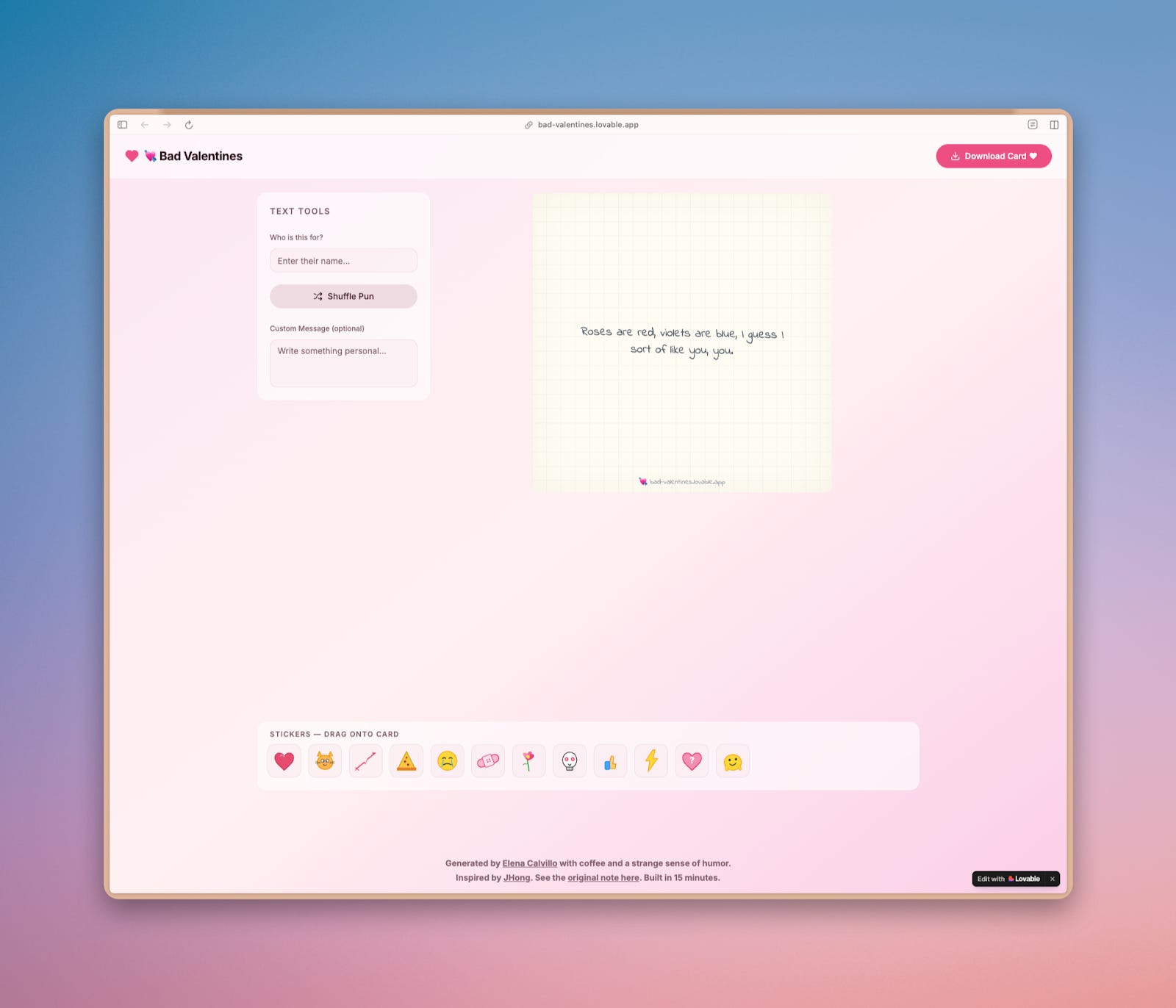
Here is the exact prompt I used to start that project. I wasn’t asking for a “vibe.” I was describing a machine:
“Build a high polish Valentine card creator called LoveNote. Use glassmorphism for the editor UI to make it look professional, but use a paper texture and the Indie Flower font for the card itself so it feels handwritten and chaotic. Add a drag and drop sticker tray with crudely drawn SVGs. Include a shuffle pun button that pulls from a hardcoded array of bad puns. Add a download card button using the html to image library.”
The outcome isn’t just a web app. It is a faster version of me. I built the AI Advent Challenge and DraftKit using this same logic. I didn’t wait for a roadmap. I just started describing the problem until it became a tool.
When you learn to think in systems, you stop being a spectator. You become the person who says “I can fix that” and actually has a working version by Monday morning. You don’t just build products. You build leverage.
Go build something badly
Learning to build with AI isn’t about becoming technical. It’s about expanding what you’re capable of in service of your mission.
The founders who make this shift don’t become developers. They become more dangerous, irreplaceable versions of themselves — people who can see a problem, think through it in buildable terms, and bring to existence something only them can create.
That combination of domain expertise and building ability is rare. It’s the kind of edge that gets harder to compete with over time.
So take the thinking Elena laid out and apply it. Pick one business problem you’ve been sitting on. One thing you’ve been waiting to hire someone for, or waiting until you “understand AI better” to attempt.
Try to build it. Badly. Slowly. Full of errors.
That discomfort you feel — the choppy start-stop-evaluate rhythm that feels nothing like your creative work — that’s the process working. Not failing.
The tools will keep getting easier. They always do. The thinking is the part that compounds.
Start there.
P.S. Elena writes Prompt Led Product, where she breaks down AI building for people who lead products without writing code. If this piece helped you think differently about building, her newsletter will take you further. Read it here.
 | A guest post by
|
Yes! Domain expertise and the ability to build a solution yourself are truly game changers!
Those who grab the proverbial bull by the horns and get it done are going to profit handsomely!
The world has changed and most people don’t even know it yet.
I’m currently working on a comprehensive app that would have been impossible for me to bring into the world without big $$$ and a team of developers.
A year ago, it was impossible. Now? The sky is the limit!
Most people don't know what questions to ask as they're low on both context and skills sets. I'm loving the chaos though. Just wish I was 25 and a time billionaire again 🤓