
Create A Digital Product With AI
Build your first infoproduct with $0 in 3 hours


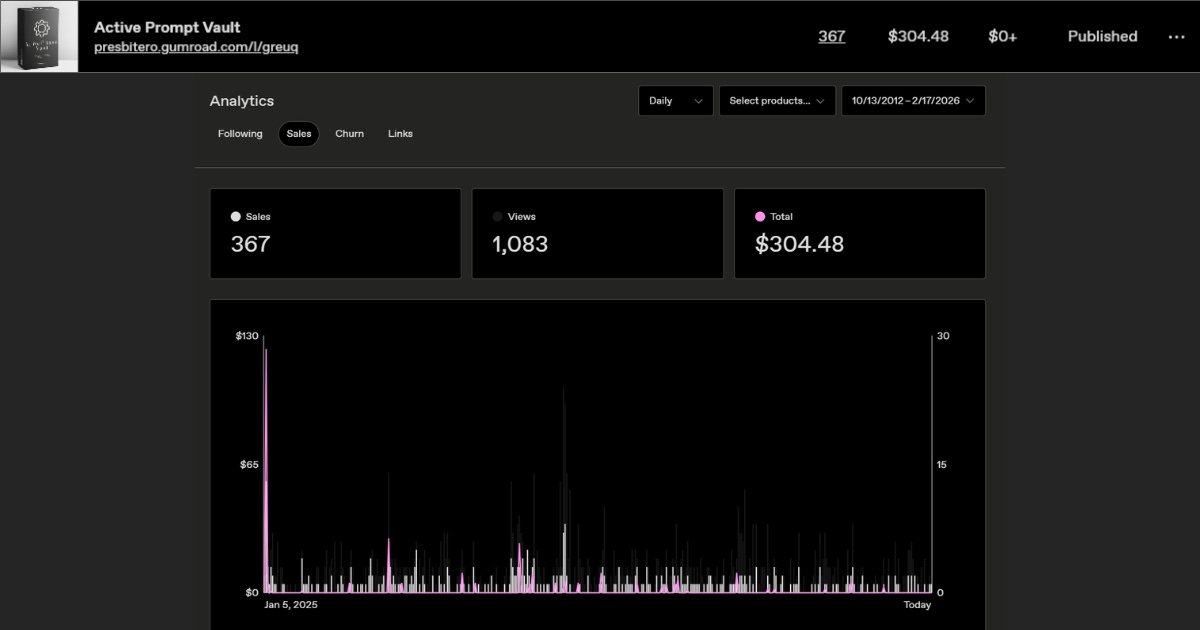
My first product took two hours to build, cost $0, earned $300, and made me $4000 (screenshot below).
It was a prompt database. Not even a PDF, but a GDoc link. Nothing glamorous. I put together the best prompts I’d tested over months of writing with AI, organized them by use case, and listed them for sale.
Even though I listed it as a free product, people were kind enough to donate, which made me $300 over time. Later on, two of the people who bought it later booked $2,000 projects with me.
The product wasn’t a side income. But, it became a powerful client pipeline — proof that I knew what I was talking about, packaged into something someone could “hold.”
This article walks through how to create a digital product with AI. Step by step. No code, fancy AI, or technical background required.
Everyone’s building. You’re watching.
Building something tangible is one of the best ways to earn trust, loyalty, and conversion. Most founders know this. AI has made creation faster than ever — what used to take days now takes hours.
And still, people freeze. You might be in this situation, and I know because I was when I started.
Why is that? Three reasons.
You overcomplicate it
The underlying belief: your first product has to be your magnum opus.
When I first started building an audience around AI writing, I thought my first product needed to be a full AI writing platform — something that could compete with Jasper AI (I know, I know). Editing, co-writing, the whole pipeline. I had zero technical skills, vibe coding didn’t exist yet, and every competitor had teams and years of development behind them.
I felt helpless. So I gave up on the idea entirely. For months, I kept writing content but never built anything to sell or give away. The gap between what I imagined and what I could actually create felt enormous.
Then one afternoon, I asked myself a different question: What is the easiest version of this I can build with the tools I have right now?
The answer was a prompt database. That’s it. No platform, and … all the things a platform’s supposed to have, logins or something.
Instead, just a Google Doc. The most basic thing possible.
And it worked. People downloaded it, used it, shared it. Some came back months later asking for more help.
You don’t know how powerful it is
Creating something tangible that people can take home is one of the strongest brand-building moves available. It signals expertise, generosity, and follow-through — all at once.
It gives your audience something to share, reference, and return to. It creates touchpoints beyond your regular content.
And it can become a gateway to higher-value offers, the way my $10 product led to $2,000 consulting projects.
You don’t know how easy it is to make
With AI, you can build a quality infoproduct in hours. As in, research, writing, drafting, staging -- everything, without taking more than a day. Not a generic PowerPoint with recycled tips — something that moves your business forward.
The rest of this article is proof.
Why build a digital product?
Before we get into the steps, I want to address the skepticism. Because if you’ve been online for more than five minutes, you’ve seen the flood of low-quality digital products, and you’re right to be cautious.
“Infoproducts are over. Anyone can make them.”
Anyone can write, too. Writing isn’t dead — it’s bigger than ever.
People will always seek answers to specific questions. And there will always be room for hyper-specific answers from people they already trust. The market isn’t saturated with infoproducts. It’s saturated with generic ones.
“Why would anyone pay when they can ask ChatGPT?”
Information has always been free. Libraries exist. Google exists. People still buy books, hire coaches, follow specific creators, talk to therapists.
The reason hasn’t changed in decades: now that information is abundant, what’s scarce is curation. The right information, at the right time, from someone you trust. Someone who’s been where you are and filtered out the noise so you don’t have to.
When you create an infoproduct, you’re not competing with ChatGPT. You’re using the trust your audience already placed in you. They follow you for your specific lens — your experience, your frameworks, your way of explaining things. That’s not something a chatbot can substitute.
ChatGPT doesn’t know your audience. You do.
“My first product shouldn’t just be a PDF”
A PDF is “basic” the same way a letter is basic. It’s not about the format. It’s about what’s in it.
For your audience, it signals that you spent dedicated time and effort to create something. That you had something important enough to package and deliver. That alone separates you from 90% of creators who only publish feed content.
And there’s a second layer that matters just as much — the internal one.
Building a product forces you to organize a thought that’s been floating in your head. It gives you the feeling of making something. It reinforces that you can create and ship. The confidence from that compounds.
The product isn’t only for the audience. It’s for you.
Here’s what you need to do
These are simple steps.
Step 1: Find a specific, specific problem from your audience
Not “help people with marketing.” More like “help solopreneurs write their first cold outreach email that doesn’t sound desperate.”
The narrower the problem, the more useful the product. A broad product competes with everything. A specific product competes with nothing — because nobody else made exactly that thing, for exactly those people.
Three ways to find it:
Run a quick survey. A Fillout form, a poll on your feed, a question in your community.
Send direct messages. Talk to people you’ve been talking to and ask what they’re stuck on.
Use AI-assisted research. Feed Perplexity, Claude, Gemini, or ChatGPT your niche and ask what questions come up in forums, what gaps exist, what your audience is searching for.
The best problems to solve are the ones you’ve already been answering for free — in DMs, in comments, in coffee chats. Most likely, it’s something that’s attached to your wider mission, the purpose of your marketing.
If you keep explaining the same thing to different people, that’s your product waiting to be packaged.
Read more about the principle behind Unpromptable Assets here.
Step 2: Use AI to create your first draft
Answer that problem as best as you can, with AI. Start with Notebook LM.
Feed it your own content — articles, transcripts, DMs, comments — any place where you’ve already addressed pieces of this problem.
This is what I’m doing right now. I’m using Notebook LM to gather all the data I have about thinking, building, and branding with AI. That means: 19 collaborative articles, one 15+ creator survey, random interviews here and there.
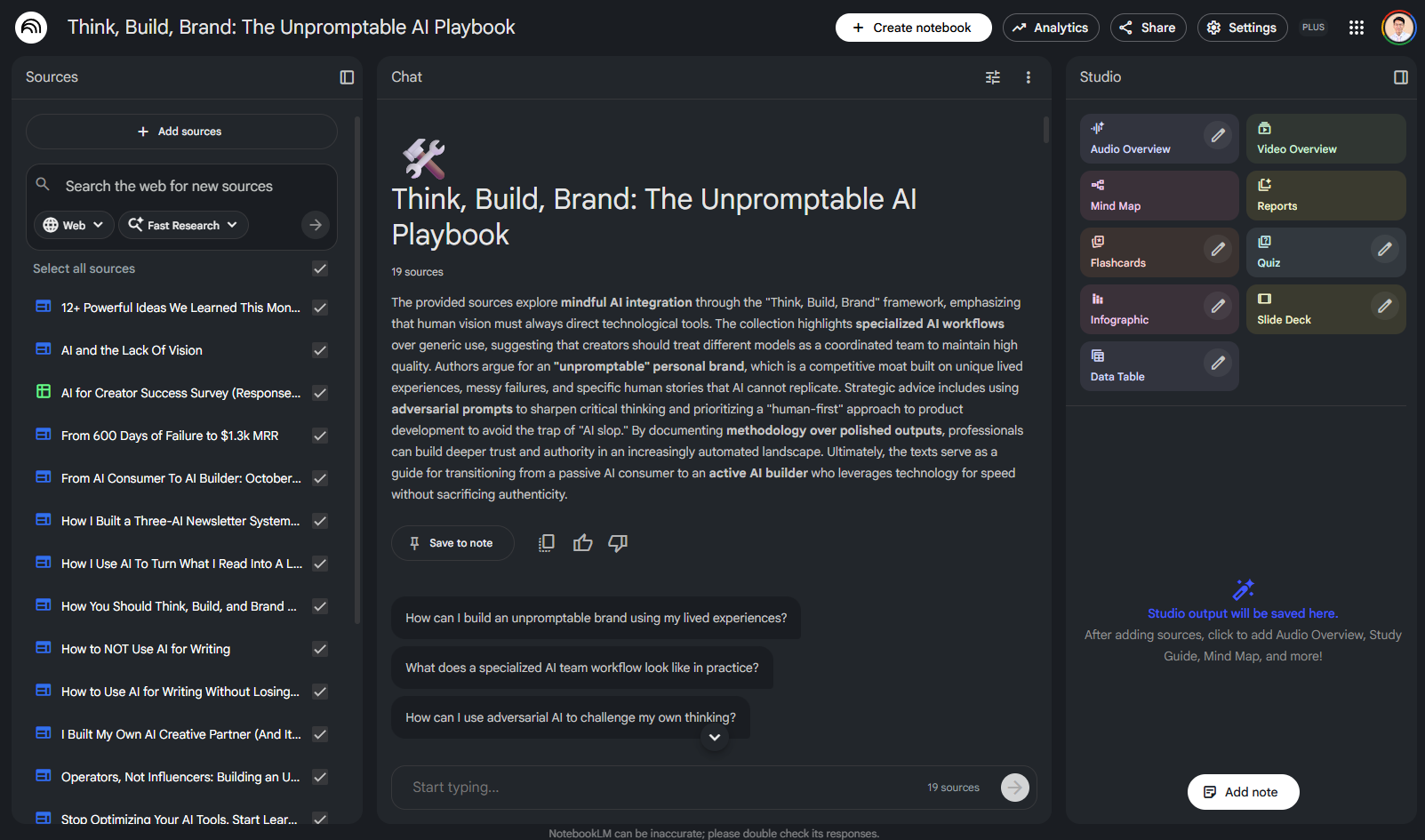
Then, I asked it questions, refined how I answered the problem, and shaped how to make it useful for my specific audience.
Then I used Claude to stitch the pieces together into a coherent, structured product that solves the exact problem.
The AI isn’t creating the insight. That comes from you.
It’s helping you find and organize what you already know.
Step 3: Add the Unpromptable Factor
Unpromptability is the unique characteristic of a brand to occupy a specific position in the audience’s mind. It’s what makes you irreplaceable. And this is what separates a generic PDF from a signature asset.
You don’t need anything special to start. Think of it as a progression.
Entry level — you already have this. A personal experience that the entire product is built around. A failure, a breakthrough, a lesson no one else lived. A question you find yourself answering again and again in DMs and comments. An opinion that goes against the common advice in your space.
Mid level — within reach. A unique methodology or framework you’ve developed through practice. Curated insights from conversations with your community — patterns you’ve spotted that no one else is publishing. Bonus content like behind-the-scenes breakdowns or annotated examples from your own work.
Expert level — for when you’re ready. Proprietary data from surveys, experiments, or client work. Information gathered from interviews or appearances. Co-created content through partnerships. Bundled access to calls, live sessions, or exclusive communities tied to the product.
The infoproducts I’m making gathers proprietary data from formal surveys, interviews, and collaborative work with experts I’ve learned from. That’s my Unpromptable Factor.
If you don’t have that yet, don’t worry. The thing to keep in mind is this: you don’t need to be at expert level to start. Your experience is already more than enough.
Step 4: Package the asset
Use Gemini to generate cover art. Edit and refine with Canva. Stage it on your site or platform of choice. Use Claude to create supporting marketing and branding materials — landing page copy, email announcements, social posts.
Keep the packaging clean and professional, but don’t lose sleep over it. “Quick, ugly PDFs” are the thing now.
More than that, if this is your first infoproduct, all the more reason not to sweat it. Publish it first. You can always “prettify” it later.
The value is in the content, the action of publishing, not the polish.
Step 5: Launch, deliver, and promote
Most people build a product, publish it once, and hope. Unfortunately, that’s a lot like pitching your lemonade stand and then wishing on a star for customers.
A real launch has a lifecycle. Here’s a quick and dirty playbook that I follow:
One to three months before: Start mentioning the problem you’re solving in your regular content. Tease that something’s coming. A month before, gather beta testers. Let a small group use it early and publish their reactions. Every week for a month, mention the product in your content. Build familiarity.
One week before launch: Mention it daily — emails, short-form content, stories. Run an early-bird promotion if it fits. One day before, a big reminder. Build anticipation.
On launch day, publish: Ask early customers to post about it. Share testimonials. Amplify any organic response. It should be the focus of your day.
One week after, keep posting daily: Share results, feedback, use cases.
One month after: Mention it periodically, wherever it’s relevant. For example; as a CTA for your articles, whenever a nice testimonial comes your way, etc.
One quarter after: Run a promotional cycle — discounts, bundles, seasonal tweaks. It’s been a year or so, and I still include The Active Prompt Vault in my CTAs, and people still download it.
And ongoing: publicize any updates or changes to the content. A living product stays relevant.
You might think you’re over-hyping something incredibly basic, that it’s too much for a PDF or a Google Doc. But it’s not.
You have to remember: the deck is stacked against you.
The internet moves fast. Your audience scrolls, likes, scrolls again, and forgets. If you don’t repeat things, there’s a thousand and one more things competing for their attention. So, promote it again and again, as much as you can stomach.
Of course, do it mindfully. You don’t want to be spamming, but you want to be persistent and consistent. That’s the line you’ll have to walk.
Building the product is the easy part. This promotion lifecycle is what turns a product into an asset.
Go build it
A two-hour product. $300 in direct sales. Two clients who turned into $2,000 projects. That’s what a single infoproduct can become when it’s specific, trust-based, and promoted over time.
Every week, someone posts on social media about how they built an app in three hours with AI. And every week, founders who don’t code scroll past it thinking, that’s not for me.
But it is for you — just not the way they’re framing it.
You don’t need to build an app. You don’t need to learn to code. You need to create a digital product that serves your audience and compounds your credibility. A PDF can do that. A Google Doc link can do that. A Google Sheet checklist can do that.
The infoproduct isn’t the end goal. It’s the seed. It proves you can ship. It gives your audience something to hold onto. It starts conversations that lead to bigger things; coaching, consulting, partnerships, systems you haven’t even imagined yet.
Just remember. You have to give yourself permission to start small. To make something imperfect, and ship it anyway.
So give yourself that permission. Open a doc. Pick one problem your audience keeps asking about. Answer it the best way you know how.
And go build it.
P.S. I’m going through these exact steps right now, building an infoproduct that answers how solos and small businesses can start using AI. It’s a practical guide paired with an AI-powered assessment. Comment or DM me if you want to get it for free when it launches.
And if you’re already past this stage and ready for a custom AI system built around your expertise — I have a waitlist open.
Your approach shows that simplicity, specificity, and trust are far more powerful than complexity when creating a first digital product with AI
I always forget that my back catalogue of content is not something that people browse leisurely, but this post has given me wings to work on my first digital paid product. Any tips on pricing?