
Operators, Not Influencers: Building an Unpromptable Professional Brand
The unpromptable way to grow professional power


This piece is part of Think • Build • Brand (TBB) — a Write10x series that breaks down how modern professionals and creators are using AI to think sharper, build faster, and brand smarter. Today’s feature tackles one of the hardest shifts in the professional world: moving from being visible to being trusted.
In this edition, I teamed up with Alex Randall Kittredge of ARK Strategy, an entrepreneur, startup advisor, and strategist — to show you how high-level professionals are turning credibility into a system with AI.
If you’ve ever wondered how to build a professional brand that attracts opportunities without playing the influencer game, this is your blueprint.
Most professional “brands” read like they were written by committee, or worse yet, by a generic AI model that learned to say nothing with 700 polite words.
Founders and operators don’t have that luxury. We’re paid to move needles, not provide good vibes. (Although some of us do that too...)
Your brand has to accelerate trust, shorten sales cycles, and attract the right rooms. That means sounding unmistakably like you while proving you can ship outcomes. In other words: becoming unpromptable: i.e. impossible to confuse with anyone else, including a model.
This piece is a playbook for founders, solopreneurs, operators and builders who want to build an unpromptable brand without becoming a full-time creator. It’s co-designed from two angles:
Credibility & proof (Alex Randall Kittredge): how to stack real-world artifacts: deals, dashboards, decision logs, so your brand isn’t just interesting; it’s got tangible ROI.
Voice & system (James Presbitero): how to extract the signal in your head, design repeatable content systems, and ship weekly without sounding like a bot.
What “Unpromptable” Actually Means
Unpromptable = specificity × stakes × system.
Specificity: You name the messy middle: the constraints, tradeoffs, and failure modes, so precisely that it can’t be faked.
Stakes: You tie takes to outcomes that matter (retention, margin, time to decision), not simply performative company values or mission.
System: I built a CustomGPT that’s trained on my career data, so that my background and experience is easily verifiable, and transferable to any job description or executive recruiter.
If your last three posts could’ve been written by a capable stranger, you’re promptable. Let’s fix that.
The Operator’s Brand Stack
Think of your brand like a robust, operator-grade system with three layers:
THINK — Positioning & POV
BUILD — Proof & Process
BRAND — Presence & Distribution
Each layer has one non-negotiable deliverable.
THINK: Positioning & POV (one-pager)
Create a one-page “Positioning Memo” you can hand to any podcast host, buyer, or recruiter.
Template
Who I serve: (e.g., “Technical CEOs at $100–$500M revenue companies undergoing M&A or reorg, or hypergrowth.”)
Jobs-to-be-done: (“Stabilize after a deal, harmonize organizations, and deliver measurable retention within 90 days.”)
Core stance (1–2 sentences): (“Accuracy isn’t enough, founders and operators need AI and process that ship decisions.”)
3 non-obvious beliefs:
“Strategy plans fail when workflows fight how humans really work.”
“Org design without key metric ownership is corporate theater.”
“Speed is a benefit, not a KPI.”
Where I refuse to play: (“I only work for companies that align with my values)
This is your source of truth. Everything you publish should trace back here.
BUILD: Proof & process (credibility artifacts)
Influencers publish takes. Founders and operators publish artifacts that show their work:
Integration Memo (before/after): 1-page brief on what you inherited, the first 3 decisions, and the outcome.
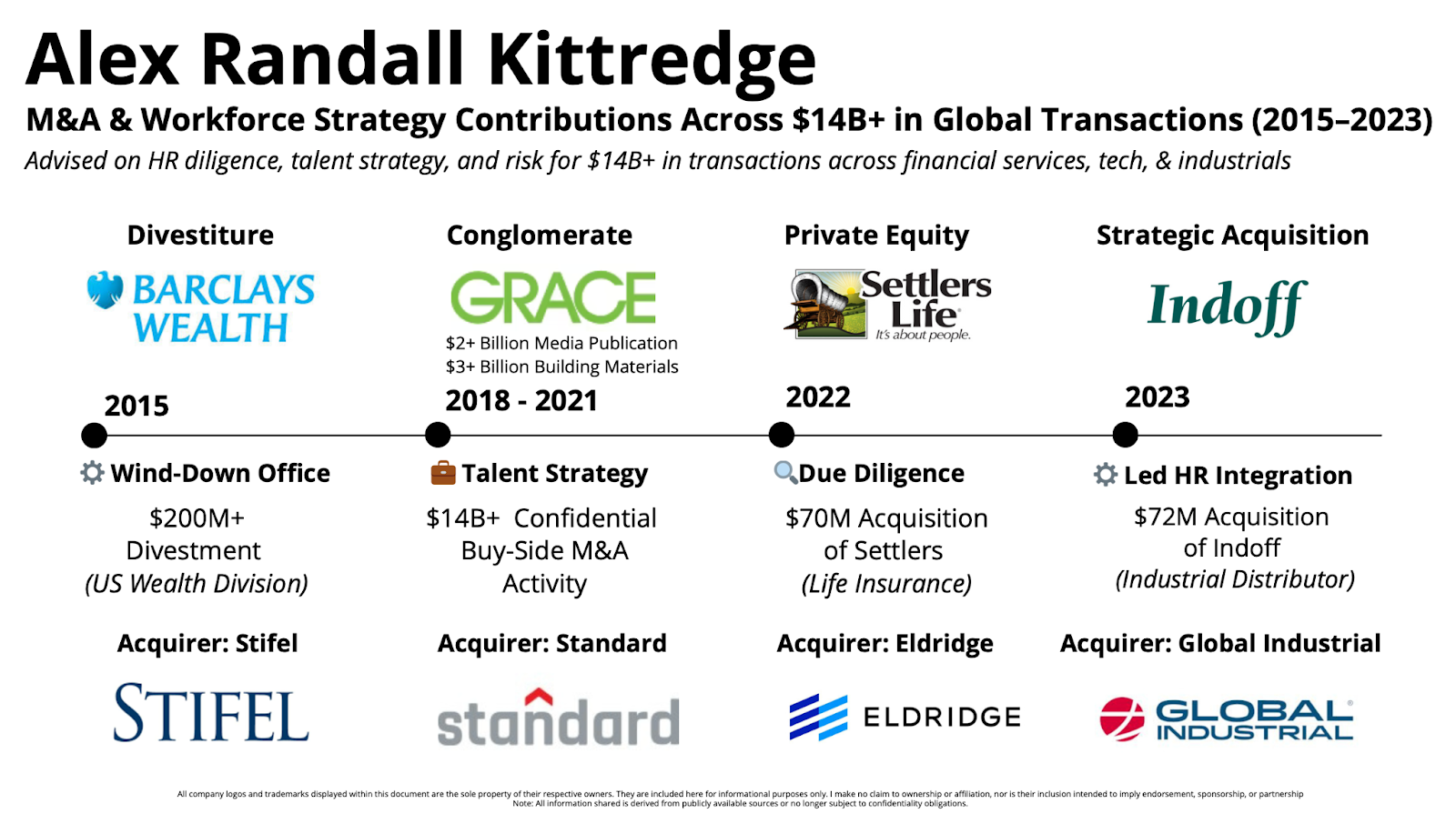
Board-Style One-Pager: Visualize the narrative of your journey in a way no resume could. Mine was compiled in hindsight, and represents my corporate journey before I pivoted to being a founder and creator:
Metrics Narrative: “Resolved 18 overdue audit items (2+ years) in 11 months, implementing governance improvements that achieved >$1M+ in labor productivity cost savings.”
Publish sanitized versions. If you can’t publish, describe the shape: the choice, the tradeoff, the measured effect. This is how your brand becomes unpromptable and investable.
BRAND: Presence & distribution (operating cadence)
You need a shipping rhythm that’s sustainable for a working solopreneur. Use this 4-part loop:
Week 1 (THINK): One stance post (250–400 words) on a real tradeoff you’re seeing.
Week 2 (BUILD): One artifact (template, memo, schematic) + 2–3 lines of context.
Week 3 (BRAND): A “decision story” (150–300 words): the moment you nearly chose wrong and why you didn’t.
Week 4 (SHIP): A live teardown or Q&A turning reader problems into shared artifacts.
This is speed with soul: light lift, high specificity, always tied to concrete, measurable outcomes.
But, what should you write about?
Alex has already systematized how to position yourself, build proof, and create the structure of an operator-grade brand. But once that system is in place, another problem appears — most professionals still don’t know what to talk about.
They chase frameworks, content calendars, or polished branding tips… but end up sounding like everyone else.
Their mistake? They talk about work instead of from within their work.
The result is content that’s technically sound but emotionally flat — credible on paper, forgettable in practice.
Unpromptable brands don’t come from templates. They come from lived experience, shared in ways that reveal both skill and soul.
Build a story system
Founders don’t need to become storytellers. They need a repeatable story system that turns daily work into meaningful proof.
Think of it as the emotional core of Alex’s Operator Stack:
his Positioning, Proof, and Process meet your stories, patterns, and presence.
Your story system can have three parts:
Origin story: Why you care
Your origin story is the foundation of your credibility.
It reveals why your work matters to you, and helps people understand the emotional thread that runs through everything you build. Sharing the trade‑offs, failures, or turning points that shaped you humanizes your expertise. When people know why you care, they start to care too.
“The decision that taught me more than any MBA.”
“The trade-off that forced me to grow as an operator.”
“What one early failure taught me about long-term trust.”
“Why I stopped chasing efficiency and started chasing alignment.”
“The first time I realized leadership was about restraint, not control.”
Process story: How you think
Your process stories show how your mind works under real conditions. They reveal judgment, not just knowledge, which is what builds trust among peers and potential clients. By narrating your decisions, pivots, and lessons, you demonstrate competence and clarity without needing to sell yourself.
“What I measure before hiring my first operator.”
“The three things I learned from fixing a broken launch.”
“The checklist I use before greenlighting a new project.”
“The framework I rely on when making high-stakes decisions.”
“The question I ask myself before saying yes to any opportunity.”
Impact story: What changed
Your impact stories are the proof points that close the loop. They show outcomes, yes, but also the meaning behind those results — the human or organizational transformation that followed.
When people see how your work makes a tangible difference, they start to see you as an essential operator, not just a commentator.
“How we cut churn by 40% without new software.”
“What actually changed after we restructured.”
“The measurable ripple effects after changing our onboarding process.”
“What a single dashboard revealed about our company’s hidden bottleneck.”
“The unexpected upside of simplifying our reporting system.”
Cycle through these three story types monthly. Each one deepens your message in a different way — origin builds empathy, process builds authority, and impact builds belief. Together, they form a living portfolio of credibility that scales trust without requiring you to “perform.”
Stories and systems
On their own, systems sound cold. Stories, meanwhile, risk sentimentality.
But together — systems and stories — they create both velocity with depth.
That’s the essence of an unpromptable brand: Your stories make your proof human. Your systems make your stories repeatable.
Run them together, and you become irreplaceable.
 | A guest post by
|
Nicely done! Right on point.
Really valuable breakdown!