
How I Use AI To Become Irreplaceable
AI is not the enemy


I use AI in almost every part of my business.
Content creation. Brand visuals. Client strategy. Risk management. Community building. If there’s a process in Unpromptable, there’s probably an AI system supporting it.
And yet, I would like to say that I’m not replaceable.
I believe I have a recognizable voice. A thriving community. Clients who trust and pay me for my value. People tell me my work sounds like me, and people assign my name to concepts I synthesize.
This is proof that the dominant narrative about AI among is wrong.
The belief that AI use makes you inauthentic, forgettable, or replaceable misses the point entirely. That’s like saying using a computer to write isn’t real writing. The tool doesn’t determine the outcome. What you use it for, that’s what determines the outcome.
The creators drowning in AI slop aren’t failing because they use AI, but because there’s something they fundamentally don’t understand.
What separates irreplaceable from invisible
I’ve spent months studying creators who use AI. Two patterns emerged.
The first group uses AI as a slot machine. They feed it prompts, spin the wheel, and publish whatever comes out. Their content is technically competent—proper grammar, decent structure, surface-level insights. But it’s interchangeable. Remove their name, and you couldn’t tell it from a thousand other posts.
They have no mission driving their work. Or if they do, it’s thin—a veneer of “helping” stretched over a cash grab. AI becomes a crutch, obvious and replicable. They’ve outsourced their thinking, and the emptiness shows.
The second group treats AI differently. They use it to amplify something that already exists: a philosophy, a set of experiences, a specific way of seeing problems. Their AI-assisted content still sounds like them because they’ve defined what “them” means before touching a single prompt.
The difference isn’t the tools. It’s the foundation.
I call this Unpromptability—becoming so rooted in your mission, your relationships, and your unique perspective that no one with a prompt can replicate what you do. AI doesn’t threaten unpromptable creators. It accelerates them.
Unpromptability as the underlying principle for my work
Here’s what I’ve learned: AI compounds human presence when you let it.
If you just “fall,” into AI use, AI has nothing to multiply. You get more content, faster—but it’s empty content. Noise at scale. But if you’re conscious about where, how, and why AI is integrated into your work, AI becomes a force multiplier for it. It handles the friction so you can focus on what only you can do.
This principle plays out across five areas of my work, which I’ll discuss to prove that:
AI use doesn’t automatically mean inauthentic and replaceable
High-level AI use provides actual value in a solo business.
Let’s get into it.
Read more: From AI Consumer To AI Builder: October’s 12 Most Valuable Insights
AI helps me with marketing execution.
I could use AI for everything in content creation. With my system, I’d probably get decent results.
But I chose to use it only where I need assistance—not everywhere. The parts I’m passionate about, the parts that I can bring unique perspectives in, I protect. The parts that drain me, and that I’m not an expert in, I delegate with extreme prejudice.
This keeps me focused on what I do best: developing ideas, building relationships, and creating assets that compound.
Meanwhile, AI helps me:
Create drafts
Do research
Hone my ideas, and more
AI helps me show up professionally without a budget
don’t exactly have world-class entrepreneurial support and structures.
I’m just a random guy, in a random area of the country. But, AI helps me maintain a recognizable presence. A distinct brand voice and visual language across platforms. Hero images, social graphics, product mockups—all consistent, all recognizably mine, as Pinkie from AI Meets Girlboss has so kindly written about on her article.
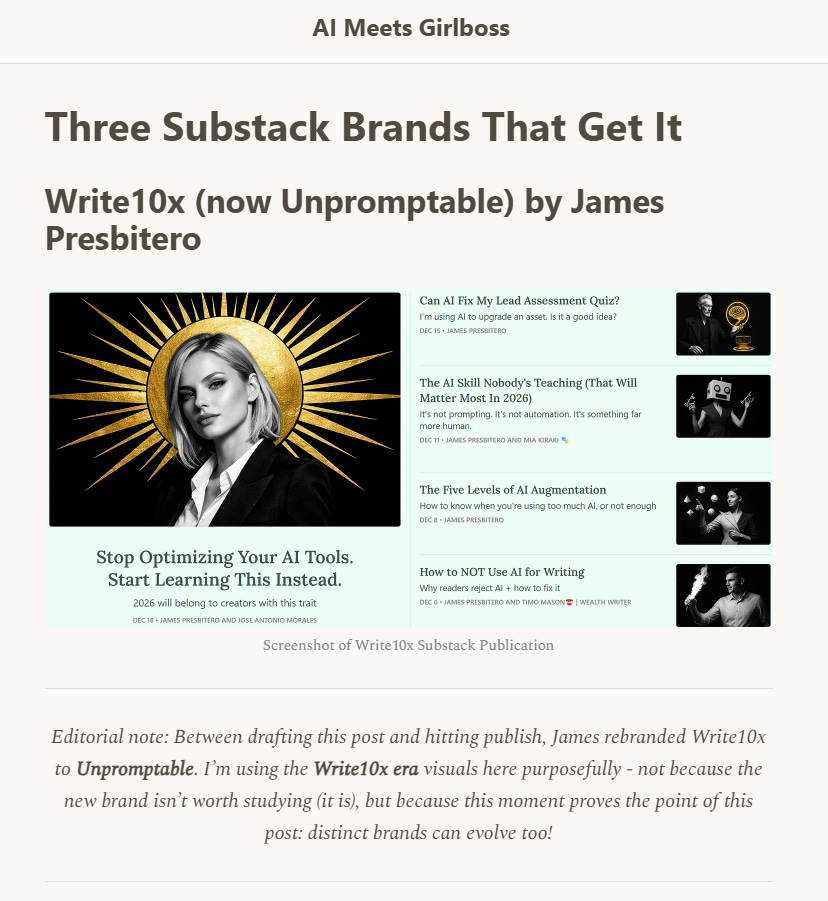
The aesthetic already existed in my head. I’ve already developed my voice from years of work as a content writer, and publishing online.
AI just helped me execute it at scale.
AI builds assets that multiply my presence
Not just infoproducts (though I create them too). Not just something that I churn out in an hour or two of prompting Claude. Actual systems:
I’m even working on a workflow to manage my finances, which will be useful once I enter agency stage. Unique, creative, and value-adding, unpromptable assets.
Each one reinforces my philosophy and gives me more time for human relationships, all built by AI.
The assets are created almost entirely with AI -- but done so with extreme nuance to my situation, my audience, my frameworks.
AI serves as a thought partner for strategy
Last week, I’d been wrestling with how to activate my community. I knew I wanted to do something, just not what. So I talked it through with AI—clarifying my goals, answering its questions, testing possibilities. By the end, I had two concrete plans:
Monday Moments. Where subscribers can spend a moment critically thinking about their work, their mission, what makes them different, and how AI fits.
Friday Features. Where everyone can feature a work, a project, or a resonant piece they would like to share that makes them unpromptable. Something unique, unmistakably them.
It begins Jan 19, 2026.
This is just a small example of how I, and most AI-ready creators I know, use AI to improve their business.
(Side note: I’ve recently read Dennis Berry coaching his clients to do the same: implement Artificial Intelligence to solve specific business problems.)
AI didn’t generate the strategy. That’s like blindly following a convincing snake oil salesman. But it helped me surface something I already felt, and guided me by refining my thinking.
AI helps me manage risks I couldn’t handle alone
I’m going to tell you something scary.
Recently, I lost access to n8n—the backbone of three client projects I’m handling.
I spent a panicked morning diagnosing the problem, narrowing it from my VPS to my browser to my ISP. I couldn’t have done it without AI, having no technical background. But I managed to solve it myself, in a morning, before the problem was even noticed.
Now AI is helping me build a Risk Management Plan to avoid being blindsided by risks like this.
Something I’d have paid consultants for, handled in-house because I have a thought partner that doesn’t sleep.
I recognize that I’m going to need experience and nuanced knowledge as I grow. But for a solo operator, this much is a godsend, helping me avoid and manage business-changing risks before they even come up.
This helped me maintain my business, marketing, even reputation, without harm. But only because I was invested and intentional about solving it.
In every case, the pattern holds: AI compounds what I already bring.
Mission. Taste. Philosophy. Relationships. Without those, I’d just be producing slop faster.
The proof that this works
Philosophy is cheap. Results aren’t.
I worked with a client in the medical industry who had never written publicly before. He had expertise, conviction, a genuine desire to help—but no system for translating that into content.
We built his Authentic AI system together: A full integration of his values, his clinical experience, and his way of thinking about patient care. Plus, we worked together on helping him build the rhythm, sense, and taste of using it: his writing routine, inspiration vault, when he should consult AI and when not to.
The AI learned to write with him, not for him.
Six months later, he’s hosted his first workshop. Attendees came from the audience he built through content written using this system. His work resonates because it carries his signal—his stories, his philosophy, his stakes.
That’s amplification, AI making someone irreplaceable.
How to know if your AI use is working
Two questions separate creators whose AI use makes them stronger from those whose AI use makes them invisible.
Would your audience recognize your work if your name was removed?
This tests whether your voice and philosophy actually survive the AI assistance. Try it: show an AI-assisted piece to someone familiar with your work, without your name attached. If they can’t identify it as yours, your human signal isn’t transferring through the process.
The fix is injecting more of you into the system. Not just writing samples—your worldview, your specific experiences, your stance on the debates in your field. I built my Authentic AI process around this: feeding the AI my values, my stories, my business context, so it has a nuanced perspective that takes even my way of thinking into account.
What did you bring to this that AI couldn’t have generated alone?
The direct test of human value-add. After every AI-assisted piece, write down your specific contribution. Not “I edited it” or “I prompted it well”—but the ideas, experiences, stakes, or relationships that shaped it.
If the list is thin, you’re replaceable.
If the list is rich—your frustrations, your frameworks, your hard-won lessons—you’re building something no prompt can replicate.
AI doesn’t automatically make you replaceable
… But it’s easier to be replaceable when you’re using it.
The tool amplifies whatever you bring—and if you bring mission, philosophy, and human depth, you become more irreplaceable than ever before.
If you only bring a vague sense of “I need to do this,” then of course you’ll fade into the background.
If you’re like me, then you’re also probably tired of all the polarizing talk about AI. AI doomsayers and AI utopianists are waging a war of attention in our feeds, and it’s difficult not to get pushed to start believing in one or the other.
But I want you to remember: AI is just another tool.
It doesn’t automatically make you inauthentic, or promptable. It won’t automatically kill your brand. However, it also won’t automatically make you great, remarkable, and unpromptable.
Ultimately, your motivations -- your mission -- is what matters. The mission you haven’t fully articulated yet, the experiences you haven’t mined for insight, the relationships you haven’t leveraged. Those are your raw materials. AI is just waiting for you to bring them.
So: do you know what you stand for?
PS. This quarter, I’m opening only three slots to build Unpromptable Assets together (one is already taken.) If you’re a founder, creator, or professional who wants hands-on help developing an AI-powered content system, lead generation strategy, etc., we should talk:
The key to being irreplaceable is using AI as a tool while adding your unique human insight, creativity, and emotional intelligence that machines can't replicate. AI handles the heavy lifting; you provide the strategic thinking and personal touch.
One essential tool I use is https://cleverhumanizer.ai/ – it's a game-changer. When I leverage AI for content creation or drafting, Clever AI Humanizer transforms that output into naturally flowing, authentic text that reflects my personal voice. It removes robotic patterns while preserving meaning, making my work feel genuinely human. This combination lets me work efficiently without sacrificing authenticity, which is what truly makes you irreplaceable in today's workplace.
Very nice, the way you frame “unpromptable” as something you design into your systems rather than a personality trait you either have or don’t. It really lands how AI just amplifies whatever foundation is (or isn’t) there: clear mission, point of view, relationships, aesthetic. It’s giving me a useful lens for tightening my own stack so my work is recognizable even when the byline disappears.